| Notes |
- The following was copied and pasted from https://www.theledger.com/story/news/1998/11/11/davenport-newswwii-veteran-recalls-attack-on-carrier/64596955007/
Davenport News WWII veteran recalls attack on carrier
By RHONDA PARKER News Chief
Nov. 10, 1998Updated Jan. 20, 2010, 10:20 a.m. ET
DAVENPORT -- Radioman First Class Bill Johnson was among 922 officers, crew and bomber plane squadron members aboard the USS Ommaney Bay escort carrier as it cruised through the Sulu Sea on Jan. 4, 1945.
Though commissioned and put to sea just the year before, the Ommaney Bay's crew and plane squadron had already distinguished themselves with a record that included 557 noncombat sorties, 878 combat sorties, the sinking or damaging of three Japanese heavy cruisers, one light cruiser, four destroyers, three battleships and the destruction or damaging of 21 aircraft in the air, and 35 on the ground.
Three invasions were supported by the "baby flat-top," as the class of carrier was known, including the key role of providing air strike support for the Palau Islands occupation and turning a threatened defeat at the Leyte beachhead into a victory.
The fleet of around 200 carriers, destroyers and battleships was moving near the Phillipines on the way to prepare for the Lingayen Gulf landings when, as Johnson describes it, "the ship shook violently, and there was a tremendous explosion. I was thrown around like a baseball in a railroad car."
Johnson, now 83, says he's forgotten a lot of things over the past 53 years, but he still vividly recalls the moment when a Japanese suicide bomber crashed into the ship carrying two bombs.
"It knocked the bridge completely off, then fell into the hangar deck ... The whole rear of the ship was on fire," he said.
Johnson said that when the attack came at around 4 p.m., he just happened to be in a portion of the ship that suffered little damage.
"I had just delivered the weather report to the weatherman's office. That was my job every day. Surviving was a case of where you were on the ship at the time. We knew we'd been hit bad," he said.
More explosions rocked the 512-foot, 7,800-ton carrier and smoke boiled up from the decks below the hangar deck, where the kamikaze's second bomb exploded, igniting gassed-up planes and stored torpedo warheads.
Johnson said he knew what to do when Capt. H. L. Young gave the order to abandon ship.
"We'd had two or three ships hit every day by these kamikazes. This is something you knew was likely to happen," Johnson said.
In the weatherman's office, a long rope was kept to ease crewmen's descent from the deck to the water in an emergency.
"It was about 35 feet down from the rail to the water. One thing none of us figured was how the rope would cut and burn our hands going down," he said.
Once in the water, Johnson said he couldn't see anything but fire and smoke. The salt water stung his cut hands and the screams of the panicked, dying and wounded filled his ears as he attempted to swim away from the burning ship.
Johnson could glimpse the far-off destroyer the USS Burns, and while still on deck of the burning carrier he had envisioned himself swimming to the rear of the destroyer, where he knew there was a ladder-type apparatus for climbing up the ship.
Johnson also faced a new threat. In addition to the intense heat, oil in the water, ricocheting ammunition and exploding torpedoes that killed two on an assisting destroyer, he found the life vest he'd been given in the weatherman's office was full of leaks.
"I had to keep stopping and blowing up the vest," he said.
During the 30 minutes to an hour Johnson spent in the water, he thought less about dying, he said, than about his young wife and the baby she'd expected in September but he hadn't yet been given word on.
"I had been to sea for three months, and I hadn't been given any mail. I didn't know I had a daughter. I just kept thinking about them," he said.
Once safely aboard the Burns, Johnson said the crew had a bucket of oil waiting for them to immerse their sore hands.
"The ships were hit so regularly, they were pretty prepared for it."
Johnson said survivors were allowed to choose clothing from below-deck reserves, and were given $5. He slept on the floor with his wallet under his head, but during the night someone stole the wallet and his $5.
"I knew I was lucky to be alive, so that didn't really bother me. There were three radiomen that I knew that were killed, and one crewman who had to have his arm amputated on the spot from his wounds."
In all, 93 men were killed and 65 wounded. The Burns was ordered to sink the Ommaney Bay after a search of the area for survivors. The Ommaney Bay's crew suffered additional casualties when kamikaze planes crashed into rescue ships, including the Burns.
Survivors were transferred to another larger ship, then taken to Borneo Bay, where they then boarded the USS Mississippi for San Francisco.
"Oh my, the great relief!" he said. "That was the happiest day of my life when I found out we were going back to the states ... The Golden Gate Bridge was the most beautiful site I've ever seen. I went from the deck down the gangplank and kissed the ground when we docked in San Francisco."
When asked about his sacrifices for his country, Johnson said, "When I got into the war in 1941, I was a 24-year-old sewing machine salesman from south Alabama. I gave up my job, I didn't get to see my newborn daughter, and I got my hands cut up a little bit when the ship sank. But I did get to come home again. Those men who were lost at sea that day will never get to come home again. There's not a day that has gone by in my life I haven't thought about them. Some of those fellows were friends of mine," he said.
Omanney Bay crew members received two battle stars for their distinguished service in WWII.
Johnson also received a citation for "excellence of service in the line of his profession in connection with operation of radio equipment and supervision of personnel in enemy waters off the Philippines," Capt. Young wrote of Johnson.
"By his energy and devotion to duty he contributed ... to the success of the ship," Young wrote.
Johnson was reunited with fellow survivors of the Ommaney Bay in September. He and his daughters, Mary Anne Suggs, who teaches music at Davenport Elementary, and Sharon Felty, a music teacher in Tulsa, were among approximately 125 former crew members and their families who attended the reunion at Mayport Naval Base in Jacksonville, where Johnson was stationed for the remainder of the war.
Johnson toured the carrier, the USS Kennedy, and had his photo made with crew members.
"It was a big thing. The Ommaney Bay would have fit on the rear deck of the Kennedy," he said.
At the reunion Johnson also won the door prize -- a quilt of the fifty states now on his bed at Bishop Gray Inn in Davenport, where he and his wife of 55 years, Majorie, now reside.
From Atlanta, the family moved to Auburndale 20 years ago, where Johnson ran a real estate business until he retired several years ago.
"I'm glad I made it, and I wouldn't want to go back, but I'm proud I served my country. I'm not afraid of my memories of the war. I put it all behind me and I've had a good life. I think we need to remember the ones who didn't come back and the people who came back disabled from the wars. We need to remember the sacrifices of all veterans," he said.
- Note from daughter, Mary Anne:
On April 30, 2000, Billy died and was buried in Andalusia. One of the last conversations I had with my dad was one in which he talked of having lived during the most fascinating time in history. He said, "I was born into a home where there was no electricity and we traveled in horse-drawn carriages. I lived to see man walk on the moon. I have lived a wonderful, happy life."
|




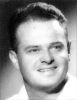
 1917 - 2000 (83 years)

