| Notes |
- Note from Rex Everage, brother-in-law:
"Charles would be surprised to learn that he influenced my life positively. In Baton Rouge, whenever he was away at work, I'd go into his study and look at his books. Charles had a good mind and selected fine literature. I was too young to understand some of his books, but I remembered them and read many of them later. Only last year did I get around to reading Dostoyevsky's The Idiot, a great book, but difficult for me even now. In my mind's eye, I can still see it on the shelf in that study, a big, grey, Modern Library Giant with the title stamped on the spine within a dark green rectangle.
And it was during the Baton Rouge visit that I first heard the great Klemperer rendition of Beethoven's 9th Symphony. Becky loved Mozart best, and Charles could listen to Tschaikovsky all day long, but he did have this recording, which remains one of the great versions of that symphony despite all the others that have appeared in the succeeding decades.
I've sometimes wondered whether Charles's love of Tschaikovsky is a clue to his character. The music of that great Russian is often extraordinarily lovely, sometimes very powerful, but marked by a profound and even hopeless melancholy. I think that Charles was always a very unhappy man, ever agitated by the riddle of human purpose but unable to accept any of the religious or philosophical or scientific solutions. And you know how important a sense of ultimate purpose is to the stability of a thinking man. By the way, I still have that recording, the Klemperer Beethoven's 9th.
The day I left Baton Rouge, Charles gave it to me, in exchange for another recording that I had and which he would pick up on their next visit to Andalusia. That unexpected act of generosity and even mutual regard must reveal something of his complex character. Charles dabbled in painting. He had considerable talent for an amateur. I recall a small painting he did of a courtyard in New Orleans, and one of his grandmother that he was rather proud of. It depicted her sunk into a large chair with light from a window falling full upon her, the shadows of the sash forming a cross over her and thus symbolizing her deep spirituality. I suppose that Larry has those paintings, and perhaps some others. The man was brilliant. If he had had greater self-discipline and a sense of purpose, what might he not have accomplished!"
Rex Everage
|




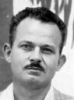
 1924 - 1991 (67 years)
